

Mental Health After 50: Why You’re Not “Losing It” — and How Therapy Can Help
Mental health is a crucial aspect of aging, and it’s common to feel concerned as you get older. However, it’s important to know that experiencing mental health challenges after 50 is not a sign of “losing it.” With the right support, including therapy, you can manage emotions, reduce stress, and improve your overall well-being. At Gold Counseling, our professional team specializes in helping older adults navigate mental health issues with compassion and expertise, ensuring you feel empowered at any stage of life. For more information, contact us to book an appointment. We have convenient locations to serve you in South Ogden UT, Kaysville UT, Draper UT, and St. George, UT.
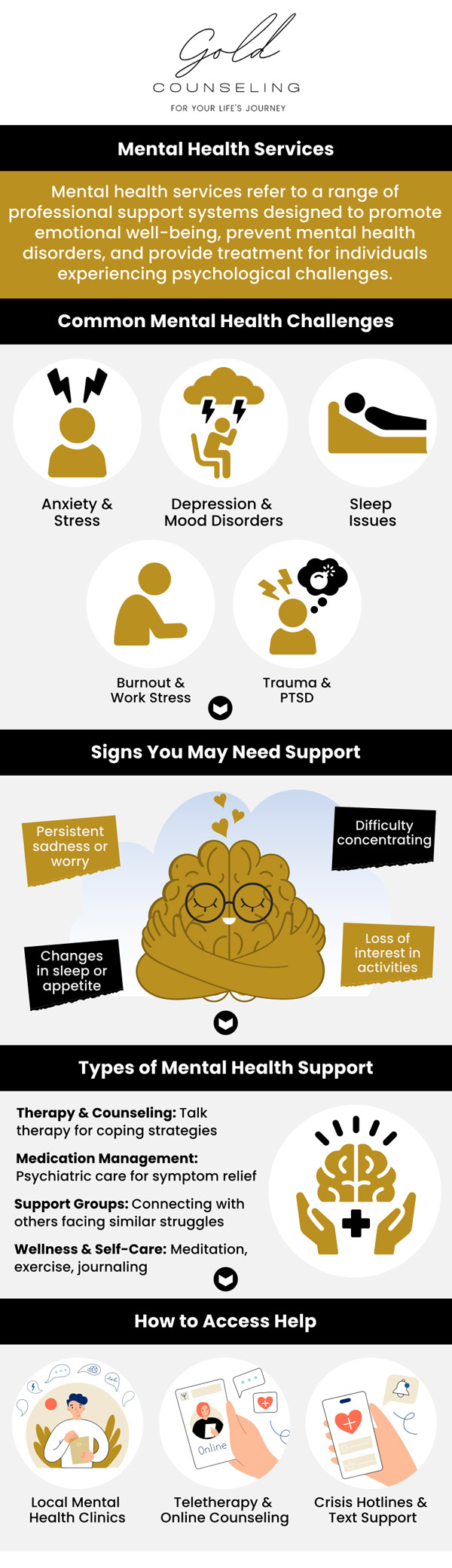
Women over 50 often face anxiety, low mood, sleep disruption, brain fog, and burnout. Learn what’s driving it and the therapy tools that help.
If you’re over 50 and noticing more anxiety, lower mood, irritability, brain fog, or sleep that suddenly acts like it has free will… you’re not alone, and you’re not “too sensitive.”
In the United States, national health surveys show that symptoms of anxiety and depression remain common in midlife and later adulthood, and many women still don’t get the support they need. Some women aren’t dealing with one issue, they’re managing a full stack: hormone shifts, sleep disruption, caregiver stress, relationship strain, health concerns, grief, and major life transitions. That’s not a character flaw. That’s A Lot…
At Gold Counseling, we see this every week: competent, high-functioning women who feel like their internal operating system updated overnight… without asking.
This newsletter breaks down what’s happening, how to know when it’s time to get help, and exactly what therapy can do; practically, not theoretically.
Why women over 50 struggle more than people realize
This season of life often includes multiple stressors at once, and they amplify each other:
- Hormonal shifts (peri/menopause) that can impact mood stability, irritability, and cognition
- Sleep disruption, which can intensify anxiety, depression, and emotional reactivity
- Caregiver overload (kids, aging parents, partners, grandkids—sometimes all at once)
- Work and identity pressure: “Who am I now? What do I want next?”
- Relationship transitions: redefining of mother to mother of adults, distance, resentment, loneliness, or “roommate syndrome”
- Health changes and chronic stress that can mimic or worsen mood symptoms
Translation: your nervous system isn’t failing. It’s responding.
Signs it’s time to get support
You don’t need to hit “rock bottom” to deserve help. Consider therapy if you notice:
- Persistent anxiety, overwhelm, or panic symptoms
- Low mood, numbness, or loss of motivation
- Sleep changes that won’t stabilize
- Increased irritability or emotional volatility
- Brain fog, concentration issues, or feeling “not like yourself”
- Social withdrawal or avoiding things you used to handle
- Relationship strain that keeps repeating the same conflict loop
- Feeling stuck in grief, burnout, or resentment
If you’re having thoughts of self-harm or feeling unsafe, seek immediate support (in the U.S., call/text 988).
What therapy can provide (real tools, real outcomes)
Here’s what effective therapy looks like for this stage of life; support that’s structured, actionable, and tailored.
1) Clarity: what’s going on
Therapy helps separate:
- anxiety vs depression vs grief vs burnout
- trauma activation vs current-life overload
- hormone/sleep-driven dysregulation vs long-standing patterns
You’ll leave sessions with a clearer map and a plan—not just validation (though you’ll get that too).
2) Anxiety strategies you can use the same day
In therapy, we build skills that work in the moment, such as:
- tools to “unhook” from spiraling thoughts
- grounding techniques for panic and overwhelm
- reducing avoidance behaviors that quietly grow anxiety over time
3) Depression support that isn’t motivational posters
Therapy addresses depression with structure:
- small, targeted actions that rebuild motivation
- reducing shame and self-criticism (common fuel for depression)
- restoring pleasure, purpose, and energy through doable steps
4) Sleep stabilization that respects real life
We work on:
- nighttime worry and rumination
- practical routines you’ll actually follow
- boundary-setting around late-night “mental labor” and overstimulation
Because sleep isn’t a luxury. It’s mental health infrastructure.
5) Boundaries and burnout recovery
This is the midlife superpower, and most women were never taught it.
Therapy helps you:
- say no without a 3-paragraph apology
- reduce over-functioning and over-responsibility
- stop managing everyone else’s emotional temperature
- protect time, energy, and peace without guilt
6) Relationship repair (or relationship clarity)
Therapy can support:
- healthier communication and conflict repair
- rebuilding friendship and intimacy
- navigating resentment and emotional withdrawal
- making grounded decisions when the relationship is at a crossroads
7) Grief and “invisible losses”
Many women over 50 grieve things people don’t always name:
- identity shifts
- aging parents
- body changes
- friendship loss
- unrealized dreams
Therapy gives grief somewhere to go so it doesn’t spill into everything else.
A simple 7-day action plan (pick TWO) Not seven. We’re building traction, not turning life into homework.
- Track sleep + mood for 7 days (0–10 anxiety; 0–10 mood; hours slept)
- Book one appointment (therapy or primary care—whichever is the biggest bottleneck)
- Add a 10-minute daily nervous system reset (walk + daylight, or breath + stretch)
- Set one boundary you will hold this week
- Identify your “main stress thought” and write it down (bring it to session)
- Reduce one avoidance behavior (one call, one errand, one conversation)
- Tell one safe person what you’re dealing with—without minimizing it
How to choose the right therapist for women over 50
You’re not hiring a “nice listener.” You’re hiring a professional for outcomes.
Look for these green flags
- They ask about sleep, hormones, health changes, stress load, and life transitions
- They can explain a treatment plan (what you’ll work on and how progress is measured)
- They use evidence-based approaches like CBT, ACT, DBT skills, trauma-informed work, grief therapy, etc.
- They collaborate with your goals instead of pushing a one-size-fits-all approach
- You feel emotionally safe and appropriately challenged (growth isn’t always comfy)
Ask these questions in the first session
- “What’s your approach to anxiety/depression/burnout in midlife?”
- “How do you help with sleep and rumination?”
- “What does progress look like in your work?”
- “Do you give between-session tools or practice strategies?”
- “How do you handle menopause-related mood and cognitive changes?”
- “What’s your experience with relationship stress and identity transitions?”
Bottom line: you should leave sessions feeling understood + equipped.
Ready for support?
If you’re over 50 and feeling more anxious, down, foggy, reactive, or burned out, you don’t have to “push through” and hope it goes away.
Gold Counseling offers therapy that is:
- structured and practical
- compassionate but direct
- focused on real change, not endless talk
Telehealth available: ????️
Written by: Debee Gold, LCSW
Brief Disclaimer
This newsletter/blog is educational and not a substitute for medical or mental health diagnosis or treatment. If you’re in crisis or feel unsafe, call/text 988 or seek emergency help.
Check Out Our 5 Star Reviews



Additional Services You May Need
▸ Relationship Counselling
▸ Couples Counselling
▸ Individual Therapy
▸ EMDR Therapy
▸ Spiritual Healing
▸ Disordered Eating
▸ LGBTQIA+ Therapy
▸ Group Psychotherapy
▸ Life Coaching Therapist
▸ Depression Treatment
▸ Mental Health Clinic
▸ Life Transition Therapy
▸ Telehealth Counseling
▸ Cognitive Behavioral Therapy (CBT)
▸ Dialectic Behavioral Therapy (DBT)


 Send Text
 How May I Help You?